About Me - How Did I Get Here?
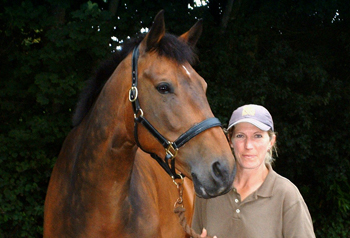
In September 2010 I qualified as an Equine Podiatrist with the Equine Podiatry Training Ltd (EPT), who run a two-year diploma course. This course has recently been Ofqual accredited to a Level 5 Diploma (Lantra Awards), and is the highest Equine Podiatry hoof care qualification available anywhere. The course consisted of many elements, including anatomy, physiology, behaviour, handling, nutrition, environment, diagnostics, gait analysis, pathologies, photography, grassland awareness, and first aid (horse and human) as well as the actual trimming. I also had to undertake eight case studies, each for a six-month period – four of which had significant hoof pathologies - and do four days shadowing another EP. (Not to mention a huge amount of reading, coursework, and three tough final exams)! So it was very thorough - I was expecting complicated, but if I’d multiplied it by about 100 I’d have been somewhere close!
I have been working as an Equine Podiatrist full time since June 2011 - just a few months after I qualified - and am a full member, and until recently was on the council of the Equine Podiatry Association UK (EPAUK) who are the only professional body for the regulation and support of Equine Podiatrists in the UK. I also now work as an Examiner, Teacher and Mentor for EPT. I have a special interest in Nutrition and completed the NRC Plus course in 2016.
The reason I initially embarked upon this? You’ve guessed it. You see, there was this horse...
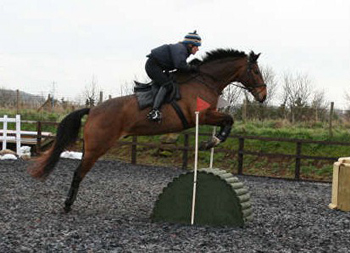
But before we come to that, some very brief background information. I am also a BHSAI, and had been teaching for almost 20 years. I’ve also run my own competition/livery/schooling yard, and have broken in, competed, schooled and generally dealt with more horses than I can remember - although I do remember the most influential ones! I hope and think I have always treated the horses with compassion, patience, understanding and sympathy to keep them happy and get the best out of them in every sense, and sought out specialist advice if necessary. The point of telling you all of this is that whilst I’ve always been fairly open minded about different approaches, my background has been traditional, and I’ve only gone looking for alternatives when traditional methods don’t seem to be working. So, over the years I’ve learnt a lot (and still am), but have quite a bit of experience to draw on, when for no apparent reason, things aren’t going quite to plan.
....So back to the horse... I bred this horse myself. I owned and competed his mother for almost 20 years, she was very special, an awesome XC horse, and it was always my plan to breed my next horse from her. I put her in foal to one of the best proven eventing stallions I could afford. Finally in May 2000 ‘Toddy’ arrived, and he was perfect! I was so excited to at last have the opportunity of producing and owning such a horse, just at the time where I felt I had enough experience, but was still young and brave enough to make a decent job of it!
We make a good start! But things don’t continue to go quite to plan..... Nothing has gone wrong, but by the time he’s 6 going on 7 and I’m wanting a bit more from him, it’s like he just can’t give me any more. He can’t engage himself for more impulsion and a bit more self carriage, a 3’ jump feels like a 5’ effort, it’s like pushing water up hill! He’s trying really hard –and I’m using up all of my experience – but we’re getting no further forward. His tack is properly fitted, he gets regularly checked by a trusted physiotherapist, and I take him to some good trainers for help. I try a few different feeding approaches, nothing makes any difference, and I begin to scratch my head a bit! I speak to the vet – we do a blood test – all normal. We do a bute trial for a fortnight to rule out any underlying pain issues – this makes no difference. I scratch my head a bit more – surely I can’t have bred a horse from this mare and stallion which is going to be such a ‘dud’?
My friend with the horse in the next stable has a ‘barefoot’ horse, and she tells me a bit more about it. I think it’s OK as far as it goes, but I want to use my horse, and anyway, his feet look fine. All the other horses I’ve ridden have been traditionally shod by the same farrier as this horse and they’ve performed well. I may not be the best rider in the world, but I’m not that bad either, especially at this level. Just in case, I get another well respected farrier to come and assess his feet and shoeing. He even watched him walk and trot up, before suggesting some lateral extensions on his hind shoes – I am impressed! Two shoeing cycles later and there’s still no difference.
In desperation and with a bit more encouragement from my friend, I decide to take his shoes off, and she persuades her ‘trimmer’ (‘trained by KC what’? I say) to take my horse on. I get tons of information at the first visit, and am relieved to have found someone who appears to be able to help. But the proof is in the pudding. I can hardly wait to ride my horse the next day.
And guess what? I’ve got the horse I always knew I must have.
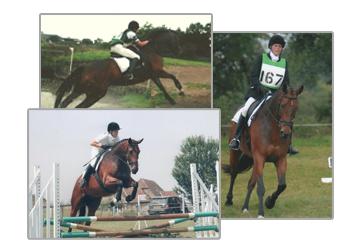
That was all many years ago now, and part of my journey since then has been twofold. I had a ‘barefoot hiccup’ due to my ignorance and maybe a lack of advice, which led me to seek an alternative solution, which is when I came across the EponaShoe. This led to me becoming the UK agent for EponaShoe for a few years and and whilst I genuinely believe that barefoot is best, I also fully appreciate that is not for every horse and owner – it can depend on so many factors to be successful, and this is where the EponaShoe fits in – all the benefits of barefoot, but with the protection of a shoe. These two approaches to alternative hoofcare and the huge difference it can make to the performance of the horse inspired me to learn about feet properly and get qualified to trim. Soon after this my Podiatry business became very busy and I now devote my work solely to this.
After spending a few years with EponaShoes on in front, and barefoot behind, behind, Toddy has been totally barefoot since 2011, and we happily continued to do whatever we liked, until he retired from competition around 2016. He remains barefoot in his semi-retirement, and still enjoys some light hacking.
In 2020, not quite ready to hang up my competition boots, I bought another nice 7 year old horse ‘Oly’ whose shoes I pulled the evening he arrived! He happily competes and jumps at low level, totally barefoot too.